


Main Exhibition
Exhibition
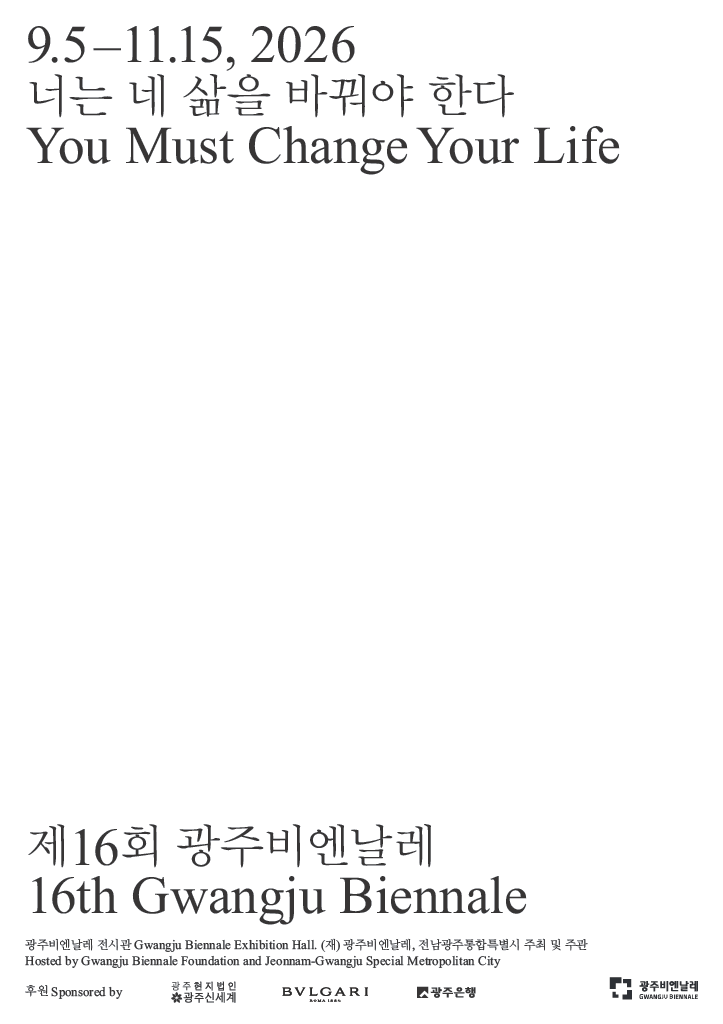
≪You Must Change Your Life≫
2026.09.05 ~ 2026.11.15
Guide to “You Must Change Your Life”
Inspired by the final line of Rainer Maria Rilke’s poem Archaic Torso of Apollo, the 16th Gwangju Biennale explores how new capacities and forms of life emerge through artistic practice.In Rilke’s 1908 poem, a fragment of an ancient sculpture releases within its viewer an overwhelming surge of emotional energy, culminating in the injunction: “You must change your life.” Yet the poem offers no prescription. Transformation remains open—urgent, but not yet determined. Taking inspiration from this imperative, the Biennale approaches change not as a destination but as a method: a process through which matter, bodies, perceptions, and relations are continually reorganised.
Change is often most immediately visible to us in moments of rupture and crisis. Yet change also unfolds quietly and unnoticed, like the changes in faces of the loved ones we see daily. And change also unfolds through the accumulation of our everyday acts and rituals as they accumulate to practices of repetition that brings about difference and. It is through such practices that we expand our capacity to affect—and to be affected.
A central proposition of this Biennale is that change is sustained through practice. But in order to be generative, any practice must be sustainable enough to repeat across multiple scales of life. Repetition is what shapes how we perceive, how we relate, and how we live. As such living models of persistence and experimentation, artistic practices appear here as cumulative techniques through which individuals and communities embody their experiences of transformation.